2026-03-29

talk about ~Ice Hockey~ It's just really fast


• Nintendo and Pax Softnica released this sports title in 1988 for the Famicom Disk System and the NES.

• Players aim to score more points than opponents by hitting a puck into the goal across three periods of play.

• Teams are built by choosing four skaters from three body types: skinny (fast), average, and fat (powerful).

• While the original sport game is played with 6 players, this game is 5-on-5. A penalty box system is also implemented, where players are sent to the penalty box if a fight goes on for too long.

• The Japanese version includes Team Japan, while the NES version replaces them with Sweden and uses different music.

• It is praised for simple, intuitive controls and strategic depth provided by customizable team rosters.

• The gameplay speed is extremely fast even on the lowest setting, making it difficult for beginners to track the puck.

• It has been re-released on modern consoles like the Switch and appears as a mini-game in Animal Crossing.

• Director Hideki Konno later became a prominent figure at Nintendo, directing hits like Mario Kart and Luigi's Mansion.

• This classic is considered one of the best NES sports games for its smooth movement and timeless competitive fun.

Refarence https://www.youtube.com/watch?v=ahGO1XAqruY

2026-03-27

talk about ~Dr. MARIO~ Highly addictive background music


• Dr. Mario (1990) is a unique falling puzzle game. Mario acts as a doctor researching viruses until Nurse Peach alerts him to new strains spreading in the hospital.

• Players drop two-block capsules into a bottle, matching four same-colored elements vertically or horizontally to eliminate viruses. The goal is to clear all viruses.

• It features red, blue, and yellow viruses with humorous animations. They mock you during a game over but writhe in pain when they are being eliminated.

• The rules are ultra-simple and intuitive, understandable within 30 seconds. This accessibility made it a massive hit, especially among casual players and housewives.

• The 2P mode is highly addictive. Players can set individual levels (0-20) and speeds (LOW to HI), allowing fair matches between beginners and experts.

• Iconic tracks like "FEVER" and "CHILL" are praised. Interestingly, the GB and SFC versions feature an extra melody in "FEVER" not found in the original FC version.

• Gameplay can feel repetitive at higher levels. Success often involves luck, as the specific colored pill you need might not appear when the bottle is nearly full.

• The overseas packaging features viruses with more aggressive faces. Additionally, Dr. Mario 64 was initially an overseas exclusive before coming to Japan.

• The series saw many versions like "Dr. Luigi" and a mobile game. Dr. Mario also joined "Super Smash Bros." because the director "Sakurai" wanted to use the "FEVER" theme.

• Often called a game "moms are good at," it remains a masterpiece. It originally had the prototype title "Virus" before becoming the classic we know today.

2026-03-26

talk about ~SPY vs. SPY~ Peek at the other person's screen like a spy.


• Action game based on MAD's "SPY vs SPY." Players control White and Black spies in a mansion to outwit rivals using various traps.

• In Japan (FC), spies Heckel and Jackel fight for "Jintendo's" Disk System blueprints for rival companies Kemco and Tomco.

• Collect 4 items (blueprint, passport, money, key) in a bag and escape via the airport door before time or health runs out.

• Set lethal traps like Dynamite or Buckets on furniture. Defuse them using specific items like Pliers or Umbrellas found in rooms.

• Fixed split-screen allows players to "spy" on the rival's room to learn trap locations and track their progress in real-time.

• Spies engage in melee when in the same room. The NES version adds a health bar and weapons like Knives and Clubs for an advantage.

• The NES release removed the Wire Gun trap and modified the Time Bomb's mechanics from the original 1984 version.

• Celebrated for black humor and strategy, yet criticized for poor solo CPU AI and repetitive fixed item locations.

• High-level play can lead to "trap camping" at respawn points, potentially causing real-world friction between friends.

• Spawned sequels like "Island Caper" and a 2005 3D remake. Licensing issues have made modern re-releases difficult.

2026-03-25

talk about ~Mystery Tower~(TOWER OF BABEL) Big Password is no in-game hints


• Tower of Babel is a 1986 puzzle-platformer by Namco where you climb 64 floors of an ancient tower.

• Archaeologist Indy Borgnine seeks the legendary Hanging Gardens of Babylon at the tower's summit.

• Indy faces enemies like Ur (a ghost) and Babelz (a monster that makes blocks) during his ascent.

• Players rearrange L-shaped blocks to build stairs to exits, consuming "Power" with every lift.

• Exclusive to Japan for decades, it was finally released globally in 2023 under the title Mystery Tower.

• The game offers deep, strategic puzzles across 128 total levels, including the difficult "Pro" mode.

• While the BGM is highly praised for its quality, the lack of variety can feel repetitive during long sessions.

• A major hurdle is the "Big Password," which requires solving a cryptic mystery with no in-game hints.

• Overall, it is a puzzle masterpiece celebrated for its simple controls and demanding mental challenges.

2026-03-24

talk about ~Dezaemon~ From Player to Creator


• Dezaemon is a STG creation series by Athena where players design original graphics, music, and stages for various consoles.

• Users create their own; however, the game includes high-quality samples like "DAIOH GALE".

• It features deep editing tools, including an icon-based music composer and editors for 2D sprites or 3D models.

• Mostly Japan-exclusive, but Dezaemon 3D has an English fan patch and recognition in international media.

• Praised for its high freedom, allowing players to create commercial-standard shooters with an all-in-one editing suite.

• Major issues include fragile save data on SFC and extreme weapon balance flaws, particularly with the homing laser.

• Dezaemon+ added rotation effects but reduced the maximum stages from six to five and changed sound nuances.

• Later titles like Dezaemon 2 added horizontal scrolling, while Dezaemon 3D utilized 3D rendering capabilities.

• A secret dev message found 22 years later revealed a hidden method to backup data using a custom joypad port cable.

• It is a pioneering "dream-like" tool that successfully inspired many players to explore game development.

2026-03-22

talk about ~Ghouls 'n Ghosts~ The man wearing armor without a shirt has returned.


• Arthur journeys to the Demon Realm to reclaim Princess Prin-Prin's soul from Lucifer, 3 years after his first battle.

• Play as the brave knight Arthur against demonic foes like Beelzebub and the final boss, the giant Great Demon King Lucifer.

• Features new up/down shooting and Gold Armor magic. Reaching the final boss requires a special weapon during the 2nd loop.

• Known in the West as Ghouls 'n Ghosts. The US version features more armor drops from chests for easier recovery.

• Highly acclaimed for its gorgeous graphics and atmospheric soundtrack by Tamayo Kawamoto, which elevated the series' quality.

• Up-down shooting adds strategy but changes the original balance. The rigid, fixed-jump trajectory remains a challenge.

• High difficulty due to "first-time killer" traps like magicians in chests and potential soft-locks with specific weapons.

• Followed by Super Ghouls 'n Goblins. Arthur also appeared in crossovers like NAMCO x CAPCOM and Project X Zone.

• The Mega Drive port was made in 5 months. Despite its name, the "Large Scythe" weapon looks visually identical to an axe.

• Frequently cited as the series' best entry, balancing intense difficulty with rewarding, pattern-based progression.

2026-03-21

talk about ~The Transformers The Mystery of Convoy~ This game ends in 2 seconds after starting


• Released by Takara on December 5, 1986, for the Famicom, this action shooter was the company's first entry into the platform. It is based on the popular Transformers toyline and anime.

• Bridging the gap between the original series and its sequel, players control Ultra Magnus, who receives the Matrix from a dying Convoy to fight the Decepticons across different time periods.

• Players primarily control Ultra Magnus but can unlock Rodimus Prime by collecting letters. Iconic bosses include Megatron, Trypticon, and combiners like Menasor and Bruticus.

• The game features 10 stages with a unique "transformation" mechanic where players switch between robot and vehicle modes to navigate terrains and dodge attacks.

• This was a Japan-exclusive release because the "mystery" of Convoy’s death was already common knowledge in the West via the 1986 theatrical movie.

• The game is praised for its decent graphics for the era and the successful integration of the franchise's signature transformation mechanic into the core gameplay strategy.

• While its extreme difficulty is often criticized as unfair, some argue it is a manageable "pattern-based" game once the enemy behaviors and bullet paths are memorized.

• It is infamous for tiny, nearly invisible 2x2 pixel enemy bullets and a notorious Stage 9 loop that requires guessing the correct path from 729 possible combinations without hints.

• The game’s legacy led to a 2014 smartphone remake and the Q-Transformers parody anime, which explicitly pokes fun at the original game's "impossible" difficulty.

• Known for the "COMVOY" typo on its cover, the game is a legendary "kusoge" (trash game) that remains a cult classic due to its sheer absurdity.

2026-03-20

talk about ~CluCluLand~ The world is spinning around and CluClu


• Released in 1984, this action game follows Bubbles retrieving gold stolen by Unira in the underwater kingdom of Clu Clu Land.

• Bubbles (Gloopy in Japan) is a female balloonfish. She faces sea urchin enemies called Unira and the powerful Boss Unira in VS. mode.

• Bubbles moves constantly; players must grab Turning Posts to rotate or bounce off walls. Sound waves are used to stun the Unira.

• Players uncover gold ingots to clear stages. High levels add a "flipping" rule where passing over gold hides it again.

• "Clu Clu" comes from the Japanese "Kuru Kuru" (spinning). The Disk version was retitled "Clu Clu Land D" in overseas Animal Crossing.

• The game is praised for its fun treasure hunting, high-quality BGM, and engaging simultaneous 2-player mode, competitive or cooperative.

• Critics find the controls "crazy" but addictive. The challenge of not being able to move freely is both its greatest appeal and hurdle.

• High-speed movement makes grabbing posts difficult. Bonus stages are notoriously strict, requiring perfect memory and precise timing.

• Unira appears in Smash Bros. as an item. Bubbles is playable in DK: King of Swing and Mario Maker, and appears in WarioWare games.

• Known for Rupee-like gold and its rare Disk version, this is a unique, speedy action-puzzle game that defines Nintendo's creativity.

talk about ~Golden Axe~ Dash attacks, jump attacks, and occasional magic.


• Sega’s 1989 beat 'em up by Makoto Uchida. Heroes fight tyrant Death Adder in Yuria to reclaim the legendary Golden Axe.

• Three warriors seek revenge against Death Adder, who murdered their families and kidnapped the kingdom's royal family.

• Features balanced Ax Battler, magic-expert Tyris Flare, and powerful dwarf Gilius Thunderhead, each with unique skills.

• Players use a 3-button system. Kicking blue thieves provides potions to unleash screen-clearing spells and level up magic.

• Mega Drive port adds levels and "Duel" mode. International digital versions are often based on the overseas arcade build.

• Praised for its dark fantasy vibe, epic music like "WILDERNESS," and impressive magic effects that grow with levels.

• Friendly fire in co-op adds chaos. The short length (approx. 20 mins) is great for quick play but lacks deep volume.

Issues: Standard attacks have slow recovery, making it easy to get trapped. Many players rely on dash attacks to maintain control.

• Famous for its meta ending where characters escape into the real world. It remains a definitive masterpiece of fantasy action.

2026-03-18

talk about ~Bonanza Bros~ Innovative "plastic-look" graphics


• Sega’s 1990 arcade hit is a 2D side-scrolling stealth game featuring a unique 3D-style aesthetic on the System 24 board.

• In Japan, brothers Robo and Mobo are thieves raiding Bad Town, while Western versions call them security testers for the police.

• Players must collect all target items and reach a rooftop blimp within a strict three-minute time limit to succeed.

• The protagonists, Robo (1P) and Mobo (2P), are stylized characters inspired by The Blues Brothers.

• Gameplay utilizes "depth," allowing players to hide behind pillars or furniture to dodge enemy sightlines and gunfire.

• A permanent split-screen allows two players to coordinate independently, making teamwork a core strategic element.

• Praised for its stylish jazz/funk soundtrack and innovative "plastic-look" graphics that pushed 16-bit hardware.

• Criticisms include heavy jump controls and low difficulty in home versions due to infinite continues.

• The Mega Drive port removed certain arcade stages, like the Department Store, to fit memory constraints.

• Though it had no direct sequel, it birthed the Tant-R series and the duo appears in modern titles like Sonic Racing.

2026-03-16

talk about ~The Maze of Galious~(MajouDensetsuII DaimaShikyouGariusu) A prototype for "Metroidvania"


• A 1987 Konami action-adventure/RPG for MSX and Famicom, evolving from a shooter into a pioneering exploration-based game.

• Popolon and Aphrodite invade Castle Greek to rescue their unborn son, Pampas, kidnapped from the future by the evil priest Galious.

• Players switch between Popolon (stronger, variable jump) and Aphrodite (swimmer, 3-shot projectile) to overcome obstacles.

• A "Metroidvania" prototype where finding items expands the map and specific rituals are required to summon world bosses.

• MSX version reached Europe as Knightmare II, but the Famicom version stayed in Japan despite overseas advertisements.

• Renowned for its strategic character swapping, deep exploration, and an iconic soundtrack by Kinuyo Yamashita.

• Extremely high difficulty, long passwords, and "soft-locks" if a necessary character dies before completing their unique tasks.

• Influenced La-Mulana and Castlevania II; followed by the adventure-style sequel Shalom: Knightmare III.

• This game is a masterpiece that can be considered a prototype of the modern "Metroidvania" genre, centering on the exploration of a vast world and the ability to switch between two protagonists.

2026-03-15

talk about ~Puyo Puyo 2~ The "Offsetting" (Sousai) system added deep tactical depth to matches.


• Released in 1994 by Compile, this sequel became the series' most successful entry. The title is a bilingual pun on "Two" and the Japanese word for "Expert" (Tsū).

• Arle Nadja climbs a multi-floor battle tower to thwart the Dark Prince's plans to steal her heart and Carbuncle.

• The game features 33 unique opponents from the Madō Monogatari universe, including the debut of the hidden boss, Masked Satan.

• It introduced the "Offsetting" (Sousai) mechanic, allowing players to negate incoming garbage, along with "Quick Turns" and "Next 2 Puyo" displays.

• While a massive hit in Japan, international versions were limited to titles like Puyo Pop or remained largely untranslated in re-releases.

• Offsetting revolutionized competitive play by shifting focus from pure speed to strategic chain-building and comebacks.

• The interface is praised for its focused simplicity, though some critics found the visuals too similar to the first game.

• Certain hidden "extension" characters are extremely rare to encounter because players usually exceed the required score thresholds too quickly.

• Its ruleset became the definitive series standard, used in modern titles like Puyo Puyo eSports and Puyo Puyo Fever.

• The iconic "Manzai" comedy skits were cut from the arcade version due to time constraints but were famously restored in later console ports.

2026-03-14

talk about ~Final Fantasy Adventure~(Seiken Densetsu) A Moving Story


• Released in 1991 for Game Boy, this first Mana series entry began as a Final Fantasy spin-off combining action and RPG elements.

• A slave Hero embarks on a journey to stop the Dark Lord and Julius from destroying the Tree of Mana to save the world.

• Features the customizable Hero and Heroine, joined by allies like the knight Bogard and a faithful Chocobo.

• Players use diverse weapons to fight and solve puzzles, with a Power Gauge for special attacks and customizable leveling.

• Titled Final Fantasy Adventure (NA) and Mystic Quest (EU), it features iconic FF spells and creatures.

• Highly praised for Kenji Ito's moving score and a poignant narrative focused on the emotional weight of "parting".

• The heartbreaking ending has become legendary for its moving yet tragic impact.

• Issues include clunky menu swapping for items and the risk of getting stuck in dungeons if the player runs out of keys.

• It spawned the successful Mana series and received several remakes, including Sword of Mana and Adventures of Mana.

• Originally a "tennis game" concept, it became a Game Boy masterpiece known for its simple yet deeply touching experience.

2026-03-13

talk about ~Challenger~ Pressing the attack button instead of the jump button


• Action-platformer released by Hudson Soft in 1985, featuring unique gameplay across 100 scrolling screens.

• Archaeologist Challenger must rescue Princess Maria from the evil Don Waldorado on the mysterious Waldorado Island.

• Features protagonist Challenger, the kidnapped Maria, and boss Don Waldorado alongside enemies like Tama and Kara.

• The game consists of four diverse scenes, ranging from side-scrolling train action to a top-view island search.

• Originally a Japan-exclusive Famicom title, it evolved from the ZX Spectrum game "Stop the Express".

• Praised for its varied stages, rich hidden secrets, and adjustable difficulty with 16 levels.

• Scene 2's map is impressively large but feels empty, and the unique camera work can be disorienting.

• Issues include a score overflow at 6,553,500 points and rare "soft-locks" due to random item placement.

• The first level uses Schubert's "Military March" as BGM, and players can find a hidden 1UP whale.

2026-03-11

talk about ~Rock'n Ball~(Family Pinball) versatile and affordable digital pinball


• Namco released this versatile pinball game for Famicom/NES in 1989, featuring multiple gameplay styles.

• The game offers four distinct modes: Standard (Pac-Man), 9-Ball (Bingo), Battle Flipper, and Sports.

• It is notable for featuring simultaneous two-player head-to-head competition on a single screen.

• The Japanese version stars Namco legends like Pac-Man and Valkyrie, each with unique performance stats.

• The North American version, Rock 'n Ball, replaces licensed characters with six generic human avatars.

• Japanese tables feature tighter layouts and wider-spaced bumpers, making them generally more challenging.

• It is praised for its high variety, original game modes, and creative use of Namco characters.

• Critics noted that scoring in Pac-Man mode is unbalanced and 9-Ball lacks high-score tracking.

• It remains a highly-regarded, budget-friendly title that pioneered competitive multiplayer pinball on home consoles.

2026-03-10

talk about ~Ghosts Goblins~(Makaimura) "Red Arremer" Red Arrema drove players into despair early on


• Ghosts 'n Goblins is a side-scrolling action game where the knight Arthur rescues a kidnapped princess from the Great Demon King.

• Arthur travels through a monster-filled world wearing only underwear beneath his armor to save his lover from the clutches of evil.

• Red Arremer is a notorious enemy named after a programmer; its reactive AI makes it one of the toughest "walls" in gaming history.

• Arthur starts in armor, loses it after one hit, and dies on the second; armor can be recovered by clearing stages or finding rare items.

• Jumping has a fixed trajectory with no mid-air control, requiring players to memorize enemy patterns and plan moves precisely.

• To see the true ending, players must beat the game twice, as the first victory is revealed as an illusion created by the enemy.

• In overseas versions, the Cross weapon was replaced with a Shield due to religious regulations regarding iconography.

• While the stiff controls and knockback can be frustrating, the game's balanced design offers an immense sense of accomplishment.

• Progressing to the final boss requires the Cross weapon, but obtaining it is often luck-dependent as it drops randomly from pots.

• The game spawned many sequels and spin-offs, including the Red Arremer series, and Arthur remains an iconic character for Capcom.

2026-03-09

talk about ~Mega Man 2~(Rockman 2 Dr.Wily no Nazo) the first "Boss Design Contest" and "E-can"


• Released in 1988 for the Famicom, this sequel refined the original's mechanics and established the core standards for the entire Rockman series.

• Following his defeat, the evil Dr. Wily returns with eight powerful new combat robots to challenge Rockman and resume his quest for world domination.

• Alongside returning heroes, eight unique bosses appear; their designs were famously selected from fan submissions in the first "Boss Design Contest".

• Key additions include the Energy Tank (E-Can) for health, a grid-based password system, and three support items that serve as prototypes for Rush.

• The game is celebrated for its "exquisite balance," allowing high-skill players to win with the Buster while rewarding the tactical use of special weapons.

• Special weapon utility is uneven; the Metal Blade is exceptionally versatile, while the Time Stopper and Atomic Fire suffer from poor energy efficiency.

• The Boobeam Trap requires specific weapon energy, leading to tedious grinding if lost. Additionally, all stored E-Cans are lost upon a Game Over.

• The overseas version added a "Normal" mode where players deal double damage, alongside a "Difficult" mode matching the original Japanese challenge.

• Developed in just three months, its iconic soundtrack later spawned major viral internet songs like "Omoide wa Okkusenman" and "Airman ga Taosenai".

• Often hailed as a "series masterpiece," it perfected the formula and set the template for sequels with its polished gameplay and boss rush format.

2026-03-08

talk about ~Balloon Fight~ The sensation of floating, inertia, and the trauma of giant fish


• Balloon Fight is a 1984 action game by Nintendo and HAL Laboratory, originally for arcades and later the NES.

• Players control an unnamed Balloon Fighter to defeat bird-like enemies by popping balloons while avoiding a giant fish.

• Flight uses buttons to flap wings, influenced by inertia. Modes include stage clearing and scrolling survival.

• The "Balloon Trip" mode was added for consoles. International sequels were rebranded for the Japanese market.

• Simple rules and white-knuckle multiplayer make it an accessible, addictive classic for players of all ages.

• While co-op is intended, players often pop each other's balloons, leading to chaotic and competitive "real-life" battles.

• Inertia-based movement is hard to master.Crowded stages and lightning hazards often lead to frequent, frustrating deaths.

• Satoru Iwata famously programmed the scrolling "Balloon Trip" mode in just three days near the end of development.

• The game influenced water physics in Super Mario Bros.. Characters also appear in the Super Smash Bros. series.

• It is a masterpiece of early Famicom action, offering timeless fun and remaining a top choice for casual multiplayer gaming.

2026-03-07

talk about ~Mario Paint~ Bringing the joy of making things and playing to children.


• Mario Paint (1992) for SNES was a pioneer tool bundled with a mouse, allowing users to draw, animate, and compose music on a console.

• It features four modes: Drawing Screen for art, Animation Land for loops, Sound Collage for music, and the Gnat Attack mini-game.

• There is no plot, but it features Mario, Yoshi, and original icons like Undodog and the fly-swatting boss King Watinga.

• Highly praised for its playful UI that made complex PC-style creation accessible and educational for children and beginners.

• Significant limits like only 16 colors, a single save slot, and music restricted to C major with only three-note polyphony.

• Some critics felt technical constraints made it a "novelty" that could not serve as a viable tool for serious artistic work.

• Overseas versions use English stamps, while the Japanese version includes Hiragana, Katakana, and Kanji character sets.

• It inspired successors like Mario Artist, WarioWare D.I.Y., and Super Mario Maker, which carried on its creative spirit.

• The title screen has interactive secrets for every letter, and the "Apphun" voice sound became a popular internet meme.

• A groundbreaking bridge between gaming and art that proved digital creativity could be affordable and intuitive for everyone.

2026-03-06

talk about ~The Phoenix Garo's Adventure~(Hi no Tori Hououhen) Yamato, Afterlife, Ancient Times


• A 1987 Famicom action game by Konami, based on Osamu Tezuka's Phoenix manga, notable as the first game released that year.

• Gaou, a former thief turned sculptor, travels through the Yamato, Future, and Primeval eras to recover 16 stolen Phoenix sculpture panels.

• Gaou is the only playable character. Manga characters like Akanemaru appear on the box art but are absent from the gameplay.

• Features the unique Onigawara system, allowing Gaou to place tiles to create platforms or block enemies using 99 consumable stock.

• Known in Japan as Gaou no Bouken, the game was Japan-exclusive but has the English title The Phoenix: Garo's Adventure.

• Praised for its innovative tile mechanics, exploration via hidden warps, and a high-quality soundtrack composed by Kinuyo Yamashita.

• Critics noted the difficulty is relatively low, and Gaou lacks a crouch-attack, requiring more strategic positioning.

• The "crouch-jump" command to break blocks is unintuitive, and certain boss-fight backgrounds can cause significant eye strain.

• The "Select" button allows self-destruction if trapped, and the ending features the theme song from the animated film adaptation.

• A polished, creative adaptation that blends platforming with resource management, standing as a "Golden Age" Konami classic.

2026-03-05

talk about ~Devil World~ The "Devil," the boss of the demons, commands the Forced Scroll.


• Devil World (1984) is a maze action game for Famicom/NES, developed by Nintendo and Intelligent Systems.

• Players control Tamagon, a green dragon navigating mazes while avoiding monsters and the boss, the Devil.

• It features forced scrolling; the Devil points directions for minions to move the entire maze boundary.

• Tamagon must collect Crosses or Bibles to breathe fire and eat dots, as he is otherwise helpless.

• Each round has 3 stages: eating dots, sealing the Devil with Bibles, and a bonus stage for extra lives.

• The game was not released in North America until 2023 due to policies against religious icons like crosses.

• Praised for its cute graphics and BGM, though random scrolling can make items unreachable or feel unfair.

• The sound effect of Tamagon hatching was later reused for Yoshi's egg in Super Mario World.

• The Devil boss appears as an Assist Trophy in Super Smash Bros., using his scrolling powers.

• A unique, early work by Shigeru Miyamoto that adds a challenging, dynamic twist to the dot-eat genre.

2026-03-04

talk about ~Rygar~(Arugosu no Senshi) A hardcore "macho game" with no sign of women whatsoever


• In the holy land of Argool, a legendary warrior is resurrected from the dead to defeat the Beast King Ligar and his beastmen army to restore peace to humanity.

• Features a muscular hero and five Indora gods who provide essential items. Notably, the game has zero female characters, focusing entirely on macho-style warriors.

• Blends side-scrolling action with top-view exploration and RPG growth. Players gain strength and health through combat while using special tools to reach new areas.

• The JP version has "cute" box art and a playful subtitle, while the NES version features heroic art and a brighter, more upbeat musical score.

• Highly praised for detailed graphics with multi-scrolling sunsets, smooth controls, satisfying weapon feedback, and an addictive progression system.

• Arcade fans were divided by the drastic shift from linear action to complex RPG exploration, and the JP version's cute packaging was seen as misleading.

• The original version lacked a save or password function despite its long gameplay length, and certain items like the wind pulley can be difficult to control.

• Known for "package fraud" in Japan due to cute art vs. macho gameplay. It also includes a hidden 1-million-point bonus found by hitting invisible stars.

• An ambitious masterpiece that pioneered the exploration-action (Metroidvania) genre by merging intense arcade combat with deep, non-linear growth and map design.

2026-03-03

talk about ~Ice Climber~ 2-player mode where co-op and PVP are two sides of the same coin.


• Released in 1985 by Nintendo, players control climbers scaling 32 ice mountains to retrieve vegetables stolen by a giant condor.

• 1P is Popo (blue) and 2P is Nana (pink). "More than friends, less than lovers" partners use mallets to break ice and defeat enemies.

• Mountains have 8 layers and a bonus stage. In 2P mode, the camera follows the higher player, potentially forcing the other off-screen.

• JP Topis are seals, while Western versions use yetis. The arcade version adds blizzards, 48 levels, and a butterfly boss.

• Praised for simple, addictive mechanics and varied stage hazards. Its 2-player mode allows for both cooperation and competition.

• The "sabotage" playstyle often led to real-life arguments. This unique "co-op vs. competition" dynamic became a hallmark of the game.

• Controls are stiff with heavy jump inertia, making horizontal movement tricky. Mallet swings have a delay, requiring precise timing.

• The pair became icons in Super Smash Bros. and appeared in titles like Animal Crossing, WarioWare, and Tetris DS.

• Finland's former President was a fan. Pro players use the "Itame" technique to bounce opponents in the air repeatedly during 2P matches.

• A Famicom classic that pioneered the "co-op but competitive" genre. Its influence on platforming and Smash Bros. remains significant today.

2026-03-02

talk about ~The Tower of Druaga~ The first installment of the Babylonian Castle Saga


• Pioneer Action RPG released by Namco in 1984, where Gil climbs a 60-floor tower to defeat the demon Druaga,

• Prince Gil must rescue Priestess Kai and reclaim the Blue Crystal Rod from the tower rebuilt by the resurrected demon Druaga.

• Gil uses a sword and shield; Kai is the stone-turned heroine; Druaga is the multi-armed final boss based on Babylonian myths.

• Players navigate mazes to find keys and doors, while unlocking chests by fulfilling cryptic, hintless conditions.

• Renowned for its iconic BGM by Junko Ozawa and its innovative blend of action with RPG-like character growth elements.

• Mystery-solving fueled arcade community bonding, but lack of hints was also criticized as unreasonable or unfair.

• Difficulty is extreme due to illogical chest conditions (e.g., pressing 1P Start) that are impossible without guides.

• Spawned sequels like The Return of Ishtar and an anime; characters guest-starred in games like SoulCalibur and Smash Bros.

• A cultural milestone that redefined slimes as weak enemies and remains a legendary Namco hit despite its extreme difficulty.

2026-03-01

talk about ~Umihara Kawase~ Rubber Ring Action in a Surreal and Nostalgic Dream World


• Launched in 1994, this "Rubbering Action" series uses an elastic fishing line to navigate surreal stages.

• Chef Kawase Umihara is lost in a world of walking fish; the goal is to reach exit doors and find a way home.

• Stars Kawase, whose name is a sushi chef idiom. Later titles add descendant Noko and friend Emiko.

• Use physics-based rope tension to swing and catapult through branching stages with multiple exit doors.

• Sayonara was titled Yumi's Odd Odyssey in NA, while Europe kept the Japanese title.

• Features high freedom through polished physics, smooth animations, and a relaxing, pastoral soundtrack.

• Realistic rope physics provide deep mastery but require high precision, potentially punishing casual players.

• Early games lacked tutorials. Game Overs are punishing, requiring restarts from stage one.

• Missing field numbers hint that clearing isn't everything. It's a deep, skill-based masterpiece.


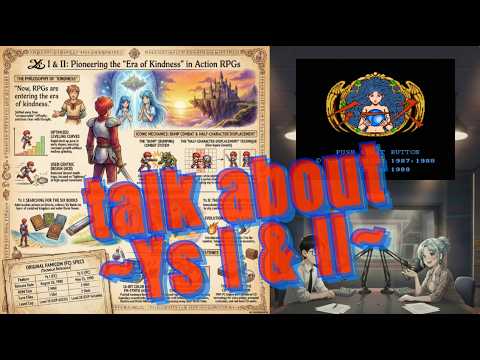
talk about ~Ys I & II~ A heartwarming and moving RPG with the half-character shift

• A landmark ARPG series by Nihon Falcom, famous for the slogan "Now, RPGs are entering an era of kindness". • Follows Adol ...