2026-01-31

~Columns~ oriental-style music and repetitive gameplay may induce drowsiness


• Created by Jay Geertsen at HP in 1989 for HP-UX, Sega later licensed this falling-block puzzle game for arcades and various consoles.

• Players arrange vertically falling stacks of three jewels to match three or more of the same color horizontally, vertically, or diagonally to clear them.

• A special multicolor jewel appears periodically, destroying all jewels on the field that match the color of the jewel it lands upon.

• While the arcade version is abstract, later ports like SFC and Columns Crown added characters like treasure hunter Cure to provide context.

• The Master System version launched in NA/EU in 1990 but skipped Japan, featuring unique backgrounds and jewel sizes compared to other versions.

• It received high praise globally; Wizard magazine even rated the Sega CD version a B+, describing it as similar to Tetris but "a bit better".

• Fans enjoy the "chain" system and aesthetic, though some find the oriental music and repetitive gameplay "sleep-inducing" during long sessions.

• It is noted for difficulty; the narrow field and reliance on "diagonal matches" make it harder to recover than Tetris or Puyo Puyo.

• The series expanded with sequels like Columns II and III, eventually featuring collaborations with Sakura Wars and Osamu Tezuka characters.

• Originally titled "Drops" during testing, Sega later provided the game's source code to assist in developing the arcade version of Puyo Puyo.

2026-01-30

~The Mystery of Atlantis~(Atlantis no Nazo) The legendary Zone 42 is "black hole"


Released by Sunsoft in 1986, rookie explorer Wynn ventures into the risen island of Atlantis to rescue his missing master from the evil Emperor Zahira.

Wynn fights with "Bom" explosives. His master's design is recycled from the game Ikki, and the final boss is the fire-breathing demon Zahira.

The game consists of 101 non-linear "zones" connected by various doors and hidden warp points, requiring exploration to find the correct path.

It is praised for its high freedom and shortcuts, allowing experts to clear it quickly.

Its fast-paced BGM is also highly regarded for its quality.

The difficulty is notoriously "unreasonable" due to tricky jump physics influenced by inertia and the risk of self-destruction from one's own bombs.

Zone 42, known as the "Black Hole," is a famous trap stage with no platforms, leading to an inevitable game over for players who mistakenly enter it.

Several zones are inaccessible during normal play, and some stages featured intense background flashing that was removed in later ports for safety.

2026-01-29

~Darwin 4081~(Darwin 4078) The Mechanics of Digital Evolution

• A 1986 vertical shooter by Data East set inside a giant spaceship where players interact with energy lifeforms called "EVOL".

• The core mechanic involves ship evolution; collecting "EVOL" items transforms the craft into 19+ forms with varied weapons and sizes.

• Taking damage or the passage of time results in "involution," usually resetting the ship to its weakest state, "PISTER".

• Unique forms like "BLACK DEAME" are reached through specific conditions, such as taking damage during the "DEAME" stage.

• Players must manage a trade-off: evolved forms provide high firepower but feature larger hitboxes, making them easier targets.

• Released internationally in March 1986; modern Arcade Archives ports include online rankings to compete with global players.

• Praised for its original evolution system, avant-garde microbiological artwork, and unique minimal techno soundtrack.

• Criticized as a difficult "death-learning" game where certain evolved forms are disadvantageous against specific bosses like "Peta-f".

• The series expanded with sequels "SRD" and "Darwin 4081," and its evolution system influenced the action game "Act-Fencer".

• Created by Tomo Furukawa as an entrance exam project; he secretly added complex mutation paths to the final product to surprise his boss.

2026-01-28

~Valkyrie no Boken~ The Dawn of a Shieldmaiden’s Legend

• An action RPG released by Namco in 1986 for the Famicom. It is the first title in the Valkyrie series, blending exploration with character growth.

• The evil wizard Zouna steals the "Key of Time," plunging Marvel Land into darkness. Valkyrie descends from the heavens to recover the key and restore peace.

• Features the shieldmaiden Valkyrie and her ally Krino Sandra (Whirlo). Notably, Valkyrie has black hair in-game despite her blonde hair on the box art.

• Includes leveling, item collection, and 7 spells. Unique mechanics determine growth rates and initial stats based on the player's zodiac sign and blood type.

• The original game was Japan-exclusive. However, its prequel, "Xandra no Daibōken," reached Europe under the title "Whirlo," featuring Krino Sandra.

• Highly praised for its beautiful BGM, charming character designs by Hiroshi Fujii, and a high degree of freedom that allows for various playstyles.

• Notorious for having zero in-game hints. Players often struggle to identify critical items or mission objectives without a strategy guide.

• Players are limited to only 8 item slots and cannot discard items. This leads to difficult management, especially when essential items fill the slots.

• Despite its cryptic difficulty, it is a landmark title for Namco, establishing a beloved heroine and a unique world that remains a fan favorite.

2026-01-27

~King's Knight~ vertical scrolling STG called "Formation RPG"

• King's Knight (1986) is a scrolling shooter by Square, uniquely marketed as a "Formation RPG" that blends action with character growth.

• In the Kingdom of Izander, four heroes must train individually and then unite to rescue Princess Claire from the evil dragon Tolfida.

• The party consists of Ray Jack (Knight), Kaliva (Wizard), Barusa (Monster), and Toby (Thief), each possessing distinct stats and weapons.

• Stages 1-4 are solo quests where players collect hidden "Ancient Treasures" to level up stats before the final team battle in Stage 5.

• The game is praised for its innovative structure and a memorable, epic soundtrack composed by the renowned Nobuo Uematsu.

• It is considered a difficult "memorization game"; missing essential hidden items can make the final stage nearly impossible to complete.

• Stage 5 is criticized for its large hit box and the inability to change character formations at will without specific items.

• This was the first Famicom game designed by Hironobu Sakaguchi. Early development plans reportedly included actual RPG dungeon exploration.

2026-01-26

~Gradius II~(Vulcan Venture) Technical Masterpiece for the Famicom


• Gradius II is a 1988 horizontal shooter by Konami for the TWIN 16 board. It evolved the series by introducing selectable weapon loadouts for strategic depth.

• Set two years after the first war, the Vic Viper is launched to defend Planet Gradius from a new Bacterian special force called "GOFER".

• The "Power Meter Select" offers four weapon types and two shield options. It retains the "back-to-checkpoint" revival system from the original game.

• The invincible "Option Hunter" appears after keeping four Options for too long. It steals them to prevent high-level players from dominating too easily.

• The overseas arcade version is titled "VULCAN VENTURE". Unlike the Japanese release, it includes a continue feature to aid players' progress.

• It won the 2nd Gamest Grand Prix for its exceptional graphics, music, and balanced difficulty. Its soundtrack by Konami Kukeiha Club is highly acclaimed.

• Early arcade versions had a bug that caused a game over at 100 lives. Some bosses also had unintended but intentional "safe spots" left by the staff.

• The Famicom port is a highly praised rearrangement. It achieved four options and voice samples using only internal hardware without extra sound chips.

• In the Famicom version, the ending track "FAREWELL" is longer than the arcade version. It is considered one of the best musical tracks in Famicom history.

• It is seen as a masterpiece of Konami's golden age. It refined the Gradius formula to near perfection and remains highly influential in the genre.

2026-01-25

~Dezaemon~ a pioneering "dream-like" tool that successfully turned many players into game creators

• Dezaemon is a STG construction series by Athena where players create custom graphics, music, and stages.

• The system provides deep editing tools, including a 29,791-color graphics editor and an icon-based music composer.

• Users create their own stories and characters, while sample games like DAIOH GALE provide pre-made examples.

• It was praised for its high freedom and all-in-one suite, which was revolutionary for home consoles at the time.

• Significant problems include a high risk of save data loss and extreme weapon balance issues, particularly with lasers.

• Dezaemon+ for PlayStation added rotation effects but decreased the maximum number of stages from six to five.

• Subsequent titles like Dezaemon 2 added horizontal scrolling, while Dezaemon 3D allowed for 3D model creation.

• A hidden 1994 dev message revealed a secret data backup method using a custom-made cable for the joypad port.

• It is highly rated as a pioneering "dream-like" tool that successfully turned many players into game creators.

2026-01-24

~Mystery Tower~(TOWER OF BABEL) masterpiece puzzle game with deep, addictive elements

• Action puzzle game released by Namco in 1986 for the NES(Famicom).

• Archaeologist Indy Borgnine seeks the Hanging Gardens atop the tower.

• Players move L-shaped stones to build stairs; jumping is impossible.

• Lifting stones consumes Power; reaching zero results in a mistake.

• Praised for deep strategy achieved through simple, intuitive stone-moving controls.

• The BGM is well-regarded and catchy, though it lacks variety across stages.

• The "Big Password" riddle is criticized for being nearly impossible without external hints.

2026-01-22

~Puyo Puyo 2~(Puyo Puyo Tsu) The cancellation system enables deep and strategic gameplay

• Released in 1994, this sequel significantly expanded the character roster and refined the competitive gameplay that became a hit in arcades and on home consoles.

• The game lacks a complex narrative; Arle Nadja climbs a six-story tower, facing various opponents to reach the final battle against Satan.

• Most characters are from "Madou Monogatari," divided into groups like the "Eight Guardians." This entry also marked the debut of Masked Satan as a secret boss.

• Key additions like "Offsetting" (Sousai), "All Clear," and "Quick Turn" shifted the strategy from mere speed to building large, powerful chains.

• While mostly a Japanese success, it was released overseas as "Puyo Puyo 2" on the Wii Virtual Console and as "Puyo Pop" for the Neo Geo Pocket Color.

• It is widely considered the masterpiece of the series for perfecting competitive mechanics. The "Offsetting" system added deep tactical depth to matches.

• The interface remained very similar to the first game, which was praised for its simple clarity but criticized by some as lacking visual innovation.

• A known issue was the difficulty of encountering hidden "extension characters" in solo mode due to the specific, easily surpassed experience point requirements.

• The "Tsu" ruleset became the series standard, inherited by later titles like "Puyo Puyo Fever" and the modern "Puyo Puyo eSports".

• The title "Tsu" is a pun on "Two" and the Japanese word for "connoisseur."

2026-01-20

~Prince of Persia~ smooth animations using the rotoscoping technique

• Created by Jordan Mechner in 1989, this action hit became famous for its lifelike, smooth animations using the rotoscoping technique.

• The evil Jaffar seizes the throne and imprisons the Princess, giving her one hour to choose marriage or death while the Prince attempts a rescue.

• Players control the Prince to defeat the wizard Jaffar, encounter a mysterious Shadow Man, and save the Princess within the dungeon.

• The game features a strict time limit instead of lives; dying restarts the level while the clock keeps running, demanding speed and precision.

• Movement is grid-based, requiring players to calculate running and jumping distances to navigate through various traps and dungeons.

• While the original has 12 levels, the SFC version expands to 20 stages with a 2-hour limit, unique traps, and new boss fights.

• It is highly praised for its realistic animation and the tension created by the time limit, although the controls require significant practice.

• Critical issues include the lack of hints for the Shadow Man boss and the difficult realistic movement that can be frustrating for beginners.

• The series evolved into 3D with the "Sands of Time" trilogy and served as the foundation for the massive "Assassin's Creed" franchise.

2026-01-19

~DRAGON BUSTER~ story of challenging dragons with sword and magic

• Released in 1985 by Namco, Dragon Buster is an action RPG,. Clovis journeys through dungeons to rescue Princess Celia from dragons.

• Players navigate a map mode to choose paths,. Side-scrolling dungeons feature room-guarding bosses and a Vitality-based life system.

• Action is centered on swordplay and magic,. Mastering the double jump and high-damage "Kabutowari" down-thrust is essential for victory.

• In international versions of the FC port, the "YELLOW JEWEL" is labeled "RED JEWEL",. This differs from the original Japanese description.

• The game is praised for its responsive, refreshing action mechanics,. Its high-quality BGM remains one of the era's most memorable soundtracks.

• Difficulty is a mixed point; mapping complex dungeons offers depth for some. However, enemies like the Wizard can be frustratingly hard to beat.

• Jumping is difficult on arcade 4-way sticks,. Repetitive dungeon patterns and limited enemy variety are also noted as minor issues.

• The title was almost "Dragon Quest" before settling on Dragon Buster,. Clovis’s unique combat pose was a clever way to save memory.

• It spawned a prequel, Dragon Buster II, and a 3D title, Dragon Valor. The game also appeared as a mini-game in Tales of the Abyss.

• Dragon Buster is considered a Namco classic,. It successfully combined action and RPG elements, rewarding players who master its systems.

2026-01-18

~The Legend of Kage~(Kage no Densetsu) Uncontrollable Giant-High-Jumping Flashy Ninja

• Released by Taito in 1985, this side-scrolling action game follows Iga ninja Kage as he rescues Princess Kiri from Yoshiro Yukigusa's demon army in the late Edo period.

• The game features the protagonist Kage, the captured Princess Kiri, and various enemies including fire-breathing monks and the demon leader Yoshiro Yukigusa.

• Players use a sword for melee and defense, and shurikens for ranged attacks. High jumps are a signature mechanic, allowing movement through trees and castle walls.

• Known abroad as "The Legend of Kage," it was ported to NES, Commodore 64, and ZX Spectrum. The NES version reached North America in August 1987.

• It is highly praised for its speedy, superhuman ninja action and its high-quality, atmospheric Japanese-style BGM composed by Hisayoshi Ogura.

• While the exhilarating jumps capture the ninja spirit, the high difficulty and the cycle of Princess Kiri being repeatedly kidnapped divide player opinions.

• A major problem is the lack of mid-air control; players cannot adjust their trajectory once jumping, often leading to unavoidable deaths from enemy fire.

• A sequel, "The Legend of Kage 2," was released for Nintendo DS in 2008. The original arcade version is also available on PS4 and Switch via Arcade Archives.

• Despite some rigid controls, it remains a representative 1980s Taito classic, beloved for its unique speed and stylish portrayal of ninja combat.

2026-01-17

~The Transformers The Mystery of Convoy~ This game ends in 2 seconds after starting

• Released in 1986 by Takara, this action shooter is a legendary "kusoge" (trash game) and was the company's first Famicom title.

• Players control Ultra Magnus to solve the "mystery" of Convoy's death, bridging the gap between the first anime and its sequel, 2010.

• The game consists of 10 stages where players must transform between robot and vehicle modes to navigate different terrains.

• Playable characters include Ultra Magnus and an unlockable Rodimus Prime; iconic Decepticons like Megatron and Trypticon appear as bosses.

• The game was exclusive to Japan, as the “mystery” of Convoy’s death was already known to overseas fans through the theatrical movie.

• It is infamously difficult; tiny, nearly invisible enemy bullets and fast-moving foes often cause players to die within seconds.

• Stage 9 is a notorious "loop" level requiring players to choose the correct path out of 729 possible combinations with no in-game hints.

• While criticized for "unfair" design and repetitive music, it is praised for faithful transformation mechanics and graphics for its era.

• The game's legacy led to a 2014 smartphone remake and a parody anime series titled Q-Transformers.

• The original Japanese packaging contains a famous typo, spelling the title as "MYSTERY OF COMVOY" instead of "CONVOY".

2026-01-16

~Sky Kid~ Unlike most shooters, the screen scrolls to the left

• Pilots Red Baron and Blue Max protect Birdland from the Mecha-Zukin army in this horizontal shooter featuring bird characters. It was released by Namco in 1985.

• Unlike most shooters, the screen scrolls to the left. Players must destroy specific targets like battleships or factories before landing at the base to clear missions.

• Biplanes tilt when moving up or down, changing shot directions to straight or diagonal. This mimics realistic flight and requires unique aiming skills.

• The "Loop" button offers temporary invincibility and allows players to get behind enemies. Performing a loop during landing grants a special score bonus.

• Players must pick up bombs to destroy targets. Carrying a bomb disables the "Loop" maneuver, making the plane vulnerable during high-stakes bombing runs.

• Being hit causes the plane to spin toward the ground. Players can recover by mashing buttons before impact, though frequent hits make recovery harder.

• It was Namco's first title with 2-player simultaneous play. Teammates can cooperate by shooting a spinning ally to help them recover faster from a hit.

• The game features a pop aesthetic and catchy music by Junko Ozawa. Playful secrets include shooting girls to turn them into "poo" or finding hidden flags.

• Despite cute art, difficulty is high due to back-attacks and slow speed. Failing to pull up immediately at takeoff results in an instant crash.

• The sequel Sky Kid DX added stages and FM sound. The BGM is a popular baseball cheer, and the recovery mechanic inspired the game SkyGunner.

2026-01-15

~Hudson's Adventure Island~(Takahashi Meijin no Boken Jima) legendary extreme difficulty "3 bats"

• Released in 1986, this side-scrolling action game is a character-swap port of Sega’s arcade hit Wonder Boy.

• Hero Master Higgins explores Adventure Island to rescue his girlfriend, Tina, from the evil King Quiller.

• Characters: Master Higgins wears a loincloth; enemies include "Coyote" and the eight-headed boss "King Quiller".

• Navigate 32 rounds while managing a depleting "Vitality" gauge, which acts as a hunger-based time limit.

• Renamed Hudson's Adventure Island overseas; protagonist "Meijin" was changed to "Master Higgins" for Western audiences.

• Unlike many celebrity games, it is praised for high-quality gameplay and catchy music by Jun Chikuma.

• Losing weapons upon death makes recovery nearly impossible in later stages due to dense enemy placement.

• The "3 bats" section in Area 8-3 is legendary for its extreme difficulty and remains a famous "trauma".

• The series saw four Famicom releases; Adventure Island IV (1994) was the console's final official title.

• The 1-UP "Toshiyuki-kun" is named after Takahashi Meijin's actual first name, Toshiyuki

2026-01-13

~Bonanza Bros~ A masterpiece of the 16-bit era that pioneered the later “stealth action” genre

• Bonanza Bros. is a 1990 Sega action game with a unique 3D-like visual style. Players control a thief duo to collect items within a time limit.

• The brothers ROBO and MOBO infiltrate "Bad Town" to find evidence of corruption. They take requests to clean up the crime-ridden city.

• ROBO is 1P in red, and MOBO is 2P in blue. Their geometric designs were inspired by the 1980s film The Blues Brothers.

• The game uses a split-screen for independent 2-player action. Players use stealth and knock out guards with doors or stun guns.

• In Japan, they are "chivalrous thieves," but in the West, they are "security testers". Overseas names were changed to Mike and Spike.

• Critics praised the "plastic look" visuals and innovative co-op gameplay. The jazz-funk soundtrack also received high acclaim.

• Some players found the jump mechanics heavy and imprecise. Others noted that the split-screen reduced visibility in single-player mode.

• The Mega Drive version removed stages like the "Department Store" due to limits. Infinite continues also made the game feel too easy.

• The duo appeared in the Tanto-R series and Sonic & SEGA All-Stars Racing. A secret command allows for invincibility.

• It is a pioneering stealth-action masterpiece that blends technical innovation with comedy. It remains a beloved symbol of Sega’s golden era.

2026-01-12

~Legacy of the Wizard~(Dragon Slayer IV) Masterful level design that emphasizes character roles

• Dragon Slayer IV (Legacy of the Wizard) is an ARPG where the Worzen family must collect four Crowns and the Dragon Slayer sword to defeat the dragon Dilgyos.

• The family consists of Zemn (Dad), Mayna (Mom), Roas (Son), Lyll (Daughter), and Pochi (Pet), each having unique abilities like flying, breaking blocks, or moving rocks.

• Players choose one member at home to explore a non-linear dungeon. Survival depends on managing LIFE and MAGIC while using character-specific items to clear obstacles.

• The Western NES version is titled Legacy of the Wizard. Character names differ (e.g., Royas/Roas), and it is the version included in modern Namco collections.

• The game features masterful level design that emphasizes character roles and a highly acclaimed soundtrack by legends like Yuzo Koshiro and Mieko Ishikawa.

•Its high difficulty, lack of mini-maps, and cryptic progression often frustrated younger players who were unfamiliar with complex PC-style exploration games.

• Long, error-prone hiragana passwords made saving difficult, and the "Scroll" item can actually reduce damage output due to the game's hit detection mechanics.

• Roas is the only one who can slay the final boss, yet he is often seen as "useless" because he can't do much until all four Crowns are collected.

• While challenging and at times unforgiving, it is regarded as a well-crafted "hidden gem" that successfully blended action and intricate puzzle-solving.

2026-01-11

~Punch Out!!~ The appeal lies in the fun of trial and error as you explore strategies

• Originally an arcade port, the NES(Famicom) version was first distributed as a non-sale prize for a Famicom golf tournament in 1987.

• 17-year-old Little Mac meets former pro Doc Louis, who decides to quit drinking and train Mac to reach the world championship.

• Players fight unique rivals like Glass Joe and King Hippo, with Mike Tyson or Mr. Dream appearing as the final boss.

• Success depends on reading patterns and counter-punching; specific hits grant "Stars" to unleash powerful Star Uppers.

• Overseas editions saw Mike Tyson's Punch-Out!! early, later re-released as "Mr. Dream" after the license with Tyson expired.

• The game is praised for its intuitive controls, rhythmic gameplay, and comical animations of diverse international boxers.

• Critics noted the extreme weight gaps between Mac and rivals, as well as the unfairness of the referee's counting system.

• Some gameplay elements like ducking are rarely useful, and the lack of a pause function can make long matches difficult.

• The series continued on the SNES and Wii, and Little Mac eventually joined the Super Smash Bros. roster as a fighter.

2026-01-10

~Fantasy Zone~ A shopping STG. The worldview and music are pastel colors.

• Released by Sega in 1986, this side-scrolling shooter features a unique manual scrolling system and a colorful "cute 'em up" aesthetic.

• Hero Opa-Opa embarks on a journey to stop a mysterious entity from building fortresses in the Fantasy Zone after a massive financial depression hits.

• Players control Opa-Opa, who faces surreal enemies and a tragic final encounter with his missing father, who was possessed by space parasites.

• Players must destroy 10 enemy bases per stage to face a boss. Defeated enemies drop coins used to buy weapons and upgrades from a floating SHOP balloon.

• The overseas NES version by Tengen features arcade-accurate colors but reduces the number of bases to six and nerfs certain weapons like the 7-way shot.

• The game is highly praised for its bright pastel-colored graphics and catchy samba-infused BGM, breaking the mold of dark, sci-fi shooters.

• The boss rush in the final stage provides an intense challenge, but the sudden, somber ending creates a sharp contrast with the game's cute appearance.

• A major frustration is that all purchased upgrades are lost upon death, and weapon prices increase permanently after each purchase.

• It became a legendary franchise with sequels like Fantasy Zone II and Super Fantasy Zone, with many ports appearing on Saturn, PS2, 3DS, and Switch.

2026-01-09

~Mendel Palace~(Quinty) original "flipping" mechanic, Game Freak's creative roots

• Game Freak's debut indie game, later published by Namco in 1989,. It was developed by hobbyists without official dev kits, a rarity at the time.

• Carton journeys to rescue his girlfriend Jenny from his jealous sister Quinty and three older brothers,. The plot resembles a comical family drama.

• Players "flip" panels on a 5x7 grid to knock enemies into walls,. Clearing a stage requires defeating all enemies or locking all floor panels.

• Unique panels like Star (1UP), Sun (flips all), and Attack (launches player) provide strategic depth,,. Items must be touched in the center to trigger.

• Two players can cooperate as Carton and Parton,. They can launch each other to attack or interfere with one another, similar to Balloon Fight.

• Overseas, it became "Mendel Palace" with a new plot about saving Princess Candy from nightmares,. Character names and some graphics were also altered.

• Praised for its original "flipping" mechanic, fine character animations, and a high-quality soundtrack by Junichi Masuda,,. Miyamoto also gave high praise.

• The lack of a save or password system is a drawback, as clearing all 100 rounds takes significant time. Initial player speed can also feel frustratingly slow.

• Success led to Game Freak's incorporation as a company. It was later re-released on Wii U Virtual Console and included in the Namcot Collection for Switch.

• With 100 rounds and a difficult "Extra" mode, it is a highly regarded action-puzzle masterpiece that showcases Game Freak's creative roots.

2026-01-08

~Rock'n Ball~(Family Pinball) versatile and affordable digital pinball

Released by Namco in 1989, it is a multi-mode pinball title for the NES(Famicom).

Features six Namco icons like Pac-Man and Valkyrie, each with unique performance stats.

Offers four modes including traditional pinball, bingo-style Nine-ball, and competitive versus play.

The US version, Rock 'n Ball, replaced Namco characters with generic ones.

Highly praised for its diverse game modes and strategic character selection.

Nine-ball mode serves mainly to unlock hidden commands rather than tracking high scores.

The main Pac-Man table is noted for having fewer gimmicks than older pinball games.

It remains Namco’s only dedicated pinball game released for the Famicom platform.

The game was ported to Nintendo Switch in 2020 as Namcot Collection DLC.

A versatile, affordable package that successfully blends arcade characters with digital pinball mechanics.

2026-01-07

~The Tower of Druaga~ remains a legendary Namco hit despite its extreme difficulty

• Pioneer Action RPG released by Namco in 1984, where Gil climbs a 60-floor tower to defeat the demon Druaga,

• Prince Gil must rescue Priestess Kai and reclaim the Blue Crystal Rod from the tower rebuilt by the resurrected demon Druaga.

• Gil uses a sword and shield; Kai is the stone-turned heroine; Druaga is the multi-armed final boss based on Babylonian myths.

• Players navigate mazes to find keys and doors, while unlocking chests by fulfilling cryptic, hintless conditions.

• Renowned for its iconic BGM by Junko Ozawa and its innovative blend of action with RPG-like character growth elements.

• Mystery-solving fueled arcade community bonding, but lack of hints was also criticized as unreasonable or unfair.

• Difficulty is extreme due to illogical chest conditions (e.g., pressing 1P Start) that are impossible without guides.

• Spawned sequels like The Return of Ishtar and an anime; characters guest-starred in games like SoulCalibur and Smash Bros.

• A cultural milestone that redefined slimes as weak enemies and remains a legendary Namco hit despite its extreme difficulty.

2026-01-06

~Keru Naguuru~ Blending fighting and RPG elements to create a unique Action RPG hybrid

Keru Naguuru is a 1989 Famicom game by Namco, blending fighting and RPG elements to create a unique Action RPG hybrid.

Players travel across a China-themed map to become the Tenkaichi Bushi, fulfilling the dream of the protagonist's mother.

The game features 15 default fighters; all characters share one sprite model with different colors to save memory.

Combat uses simple controls where all moves are triggered by one button and directional inputs, with no complex commands.

Players learn 14 techniques by visiting temples and completing "errand-run" tasks for various immortals across the world.

Praised for smooth animations and pioneering "guard" and "counter" systems that predated modern 3D fighting games.

Mixed reviews cite tedious item-collecting quests and the "clash" of techniques where new moves overwrite older ones.

The title is a pun on "kick" and "punch," and the world is filled with parodies of Dragon Quest and Final Fantasy.

2026-01-05

~Egg Monster Hero~(Hanjuku Hero) Philosophy of “Soft-boiled”: Rejecting Perfection (Fully-boiled)

• Released by Square in 1992 for the Super Famicom, this real-time simulation RPG is the highly-regarded second entry in the series. It evolved the original Famicom version's concepts with enhanced humor and dynamic systems.

• After the Almamoon Kingdom’s unification, the lazy Prince loses territory due to his indolence. He must lead the "Hanjuku" (half-boiled) army to defeat the "Kanjuku" (ripe) army and its leader, Ripe Queen.

• The cast features the lazy protagonist, the stressed Minister Sebastian, and numerous generals named after foods, myths, or parodies of Final Fantasy characters like Kain and Rydia.

• The game features "not-so-busy" real-time strategy on field maps and command-based battles where generals summon Egg Monsters (Egumon) from magical eggs to decimate enemy troops.

• While the Japanese title is Hanjuku Hero: Aa, Sekai-yo Hanjuku Nare...!!, the official name for the overseas version is "Egg Monster Hero".

• The game is praised for its polished humor, creative boss castle designs, and the grand orchestral soundtrack composed by Koichi Sugiyama, which creates a funny contrast with the wacky visuals.

• General recruitment is purely luck-based, and a unique "trap" exists where reaching the maximum Hanjuku level causes eggs to only summon useless monsters like Lampkin as a joke.

• Issues include uneven battle balance where Egumon are overwhelmingly stronger than bare generals, and a bug that skips enemy fortification when certain menus are opened.

• It is hailed as a "timeless" zany masterpiece" that redefined simulation RPGs by embracing the philosophy of imperfection and parodying the gaming industry itself.

2026-01-04

~The Phoenix Garo's Adventure~(Hi no Tori Hououhen Gaou no Bouken) Yamato, Afterlife, Ancient Times

Developed by Konami in 1987, this Famicom title is based on Osamu Tezuka's "Phoenix" manga and its animated film.

Players control the sculptor Gaou, who must travel through the Yamato, Future, and Primeval eras to recover 16 fragments of a stolen Phoenix sculpture.

Other characters like Akanemaru, Buchi, or Hayame appear on the box art and in the manual but are entirely absent from the game itself.

Gaou’s primary tool and weapon is a chisel (nomi), reflecting his identity as a sculptor.

The standout mechanic is the Onigawara system, allowing Gaou to create ogre-faced tiles as makeshift platforms or shields. This creative mechanic is an early precursor to sandbox games, allowing players to build bridges and climb sheer cliffs.

The game's structure is non-linear, utilizing a complex network of hidden warps to move between 16 stages. Some warps are hidden behind destructible blocks or statues.

Known internationally as "The Phoenix: Garo's Adventure", the title remains a Famicom exclusive without an official Western NES release.

The game is highly praised for its smooth controls and high-quality audiovisual presentation. The soundtrack by Konami’s Kukeiha Club is considered a masterpiece, featuring era-specific leitmotifs and the movie's theme song in the ending.

Some fans criticize the departure from the source material's philosophy. In the manga, Gaou finds enlightenment and respect for life, but in the game, he kills animals and aliens with a chisel.

Obscure mechanics, such as the "triple-jump" required to break specific floor blocks, can frustrate players who do not read the manual.

It remains a respected example of Konami’s creative peak during the 8-bit era, combining literary adaptation with unique spatial design.

2026-01-02

~THE QUEST OF KI~ Manipulating the balloon with just the tip of a finger, guiding it through gaps

• A side-scrolling platformer prequel to The Tower of Druaga, titled THE QUEST OF KI overseas.

• Priestess KI climbs the tower alone to retrieve the Blue Crystal Rod from the demon Druaga.

• Features inertia-heavy jumping with no attacks; KI must avoid enemies through precise, delicate movement.

• Includes KI, Ishtar providing floor hints, and Quox, the spirit dragon who warps Ki upward.

• Comprised of 100 floors; later "Special" floors feature brutal ZAP traps and extreme layouts.

• Praised for beautiful character art and Junko Ozawa’s acclaimed "Departure of KI" theme.

• The canonical "bad ending" where KI is petrified upset some players due to its gloominess.

• Derived from Atari’s Major Havoc; its development code name was "Minor Havoc".

• Famous for its notorious difficulty, especially Floor 98, as highlighted in Game Center CX.

• A punishing but rewarding "death game" that demands absolute mastery of its unique physics.

~THE PORTOPIA SERIAL MURDER CASE~ The phrase “culprit is ...” is Japan’s most famous spoiler.

• Detective and partner Yasu investigate Kouzou’s murder in Kobe, leading to a legendary plot twist.

• Features the silent Boss, his partner Yasu, victim Kouzou, and his sister/secretary Fumie.

• Transitioned from PC keyboard input to an intuitive command selection menu for the Famicom.

• The FC version added 3D dungeons and cursor-based searching but lacked the PC's manual text entry.

• Its groundbreaking “no narrative” style used Yasu's dialogue to convey all information and drama.

• The FC version lacks save or password features, requiring a single sitting to complete the mystery.

• Some called the twist ending “unfair” for mystery fans, yet it became a famous cultural milestone.

• A 2023 Steam version with an English title serves as an AI Tech Preview for natural language learning.

• The phrase “The culprit is ...” is Japan’s most famous spoiler and a widespread internet meme.

2026-01-01

~Rygar~(ARUGOSU NO SENSHI) Cute packaging, but a serious worldview inside

• A warrior fights Beast King Ligar to save humanity from monsters in the ancient land of Argool.

• Muscular hero saves elder Indra gods and meets hermits; notably, no female characters appear.

• Combines action with RPG elements like growing stats and using "Diskarmor" to explore non-linear maps.

• The NES version Rygar features brighter, heroic music unlike the tragic tone of the Japanese version.

• Detailed graphics with multi-scrolling sunsets and smooth controls provide a satisfying experience.

• Original fans were divided by the drastic shift from linear arcade action to RPG exploration.

• Lacked a save function despite long gameplay, making single-session completion necessary originally.

• Japanese box art is cute, but the actual game retains the macho visual style of the arcade version.

• A departure from its arcade roots, yet a masterpiece action-RPG with deep exploration and growth.

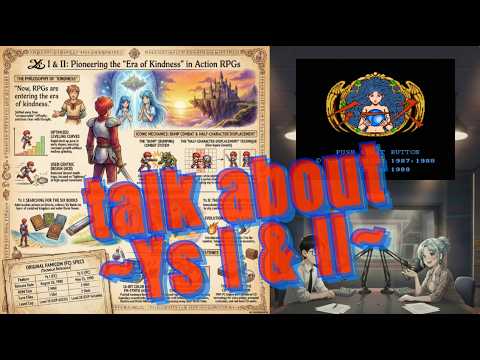
talk about ~Ys I & II~ A heartwarming and moving RPG with the half-character shift

• A landmark ARPG series by Nihon Falcom, famous for the slogan "Now, RPGs are entering an era of kindness". • Follows Adol ...